· clothink
Best Techpacker Alternatives in 2026: Which Tool Fits Your Workflow?
- Tech packs
- Fashion tech
- Product development
Updated 6 October 2026.
Techpacker is an established way to build and manage tech packs, but it is not the only option. The right alternative depends on why you are looking.
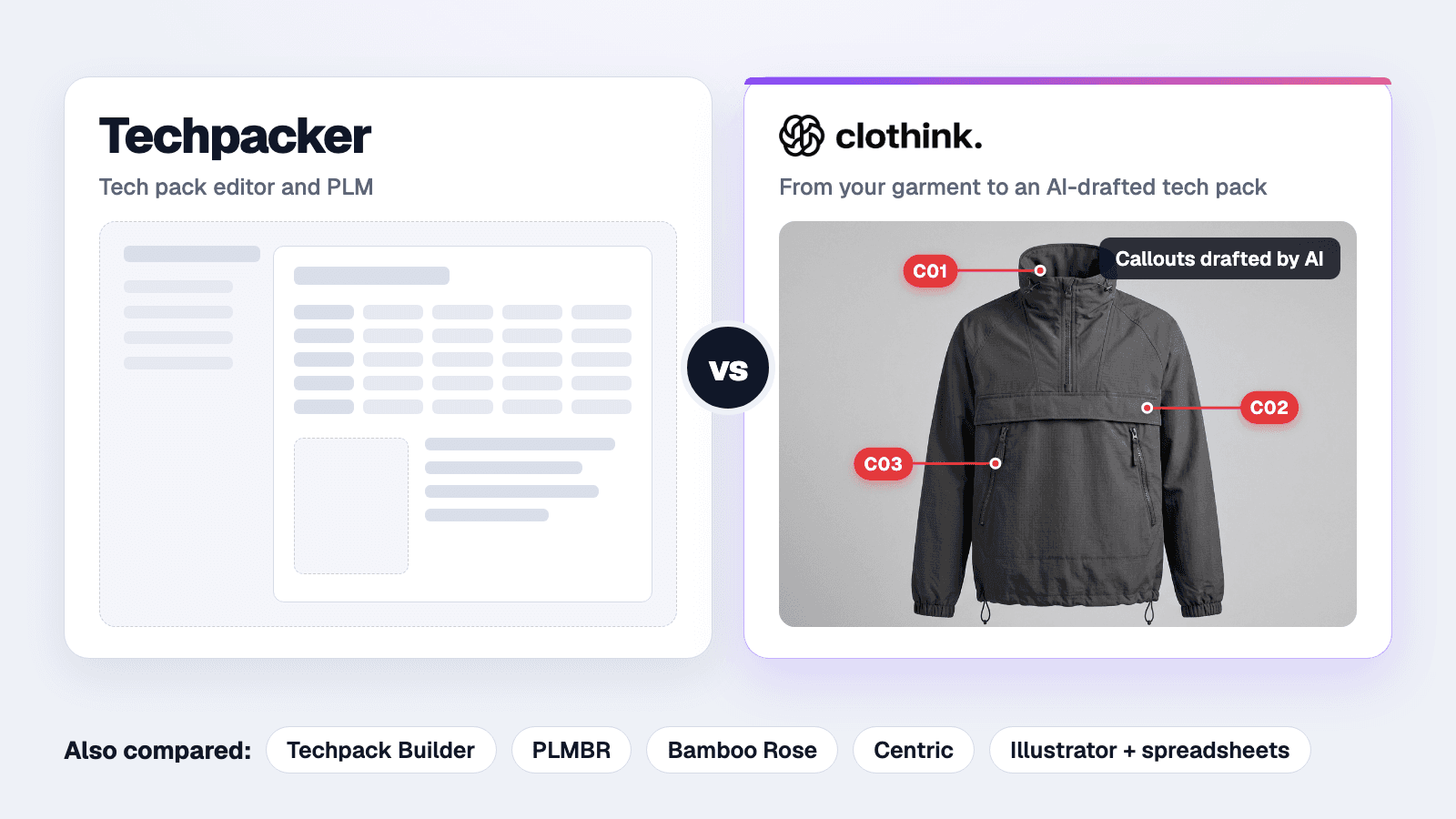
Some teams want a simpler dedicated editor. Some need full product lifecycle management across larger teams, and platforms such as Bamboo Rose and Centric go much deeper. And some find the problem starts before the tech pack: turning a design idea into visuals, refining the product, then translating the approved design into technical information. clothink takes a different approach to that. It drafts the tech pack from the garment itself, using AI, so you do not have to build templates and libraries first.
This guide compares those workflows, not just feature lists. For the wider category, see our guide to the best tech pack software for fashion brands.
Disclosure: clothink publishes this guide and is included in the comparison. Information on the other vendors comes from their published pages, checked in October 2026.
Techpacker alternatives at a glance
| Tool | Best for | Main strength | Main trade-off |
|---|---|---|---|
| clothink | Brands and product teams developing garments from concept to technical handover | Drafts the tech pack from your actual garment with AI, with design and mockups in the same workspace | Not an enterprise PLM, and no factory portal |
| Techpack Builder | Designers who want a dedicated tech pack editor without a subscription | Free desktop app that keeps your files on your own computer | Built around tech pack creation, not wider design development |
| Techpacker cloud and PLMBR | Teams already working in the Techpacker ecosystem | Collaboration, libraries and manufacturer connections around tech packs | More focused on documentation and PLM than visual product creation |
| Bamboo Rose TotalPLM and Backbone | Growing and established brands that need structured product development | BOM and spec libraries, tech pack templates, sharing and PLM workflow | More system and process than a lightweight design workspace |
| Centric PLM | Larger brands managing complex product development across teams and suppliers | Deep PLM, with Centric AI agents and an AI Studio for concepts and visuals | Much more infrastructure than most smaller teams need |
| Illustrator and spreadsheets | Very small collections with an established manual process | Flexible and familiar | More manual work and a higher risk of version drift |
First, what has changed at Techpacker?
There are now two Techpacker workflows worth separating.
Techpack Builder is a desktop app for Mac and Windows, made by the creators of Techpacker. It is free, your files stay on your own computer, and its editor shows the page as it will look: if you drag a picture of a pocket next to a measurement table, that is how it appears on the final page.
Techpacker’s cloud plans and PLMBR cover more of the product development process, including collaboration, libraries, manufacturer connections and a sync with Adobe Illustrator. PLMBR describes itself as an AI-powered PLM. Cloud plans start at $35 per user per month, with PLM Professional at $95 and PLM Premium at $125, all paid yearly. See Techpacker pricing.
What should you compare?
A good tech pack tool does more than produce a professional-looking PDF. Look at how it handles the whole workflow around the document:
- Technical information. Can you manage measurements, grading, materials, colours, trims, construction notes and BOMs clearly?
- Revision control. Can your team tell which design, specification and supplier document is current?
- Supplier handover. Can you give a manufacturer what they need without rebuilding the file elsewhere?
- Design workflow. How does the technical information connect to your CADs, sketches, artwork and approved visuals?
- AI assistance. Does AI remove repetitive drafting while your technical team keeps control of the output?
- Collaboration. Can designers, product developers and the wider team work from the same product information?
- Setup effort. Do you need to build templates and libraries before the tool is useful, or can it draft from the garment itself?
- PLM depth and cost. Do you only need to develop products, or also manage sourcing, costing, compliance and approvals? What does the system cost to buy and to adopt?
A more powerful system is not automatically a better fit for your team.
clothink: best when design development and the tech pack need to stay connected
clothink starts earlier in the process. A style can begin as an idea, a reference or a sketch. You develop sketches and artwork, generate product or on-model mockups, and use the chosen design as context for an AI-drafted tech pack. The sketches, mockups and technical information stay together in one workspace.
Starts from your garment, not a template library
Tools built around templates and libraries ask you to set those up first: page layouts, size specs and BOM libraries, filled in again for each style. clothink works the other way round. Auto-Complete reads the sketch and mockup of the garment you are developing and drafts the pack for that specific product, so you do not need to build a template library before you get a useful first draft. You can save a house format on a Brand (page order, cover and BOM columns) and reuse fabrics and trims from the material library, but neither is required to start.
AI-drafted technical information
Auto-Complete drafts size charts, a How to Measure guide, a bill of materials, fabric and colour information, construction notes and numbered callouts on the sketch. The result is a starting point, not a production approval: check measurements, materials and construction before anything goes to a supplier. The value is editing a structured first draft instead of starting every section from an empty table. For a deeper primer, see what an AI tech pack is.
Auto-Complete Agent
Building your tech pack with AI
Visual analysis
Materials & colours
Size chart
How to measure
Bill of materials
Construction notes
Callouts
Mockups and tech packs in one workflow
A common workflow uses one tool for CADs, another for visualisation, and spreadsheets or specialist software for the tech pack. clothink is designed to reduce those handovers. A sketch or a written description can become a photoreal product visual, and the approved design then gives context to the technical draft, so the visual direction and the specification stay aligned as the product changes.
PDF and Excel handover
A reviewed tech pack exports as a branded PDF and an Excel file for supplier communication. The Free plan needs no card and lets you build and edit up to three tech packs, with 10 starter tokens for AI images and a free first Auto-Complete run. Unlock a pack for £15 to download it, or choose a paid plan from £19 a month with every export included. See clothink pricing.
When clothink is not the right choice
clothink is not an enterprise PLM and has no factory portal. It is a web workspace, so there is no offline desktop app. If you need formal sourcing workflows, deep ERP integrations, compliance management or supplier portals across a large organisation, one of the PLM options below fits better.Techpack Builder.
Choose Techpack Builder if you already know what the product is and mostly want a better way to document it. Choose clothink if you also want to develop and visualise the design before it becomes technical information, or if speed matters. Auto-Complete drafts the BOM, size chart, construction notes, How to Measure guide and callouts from your garment, usually in two to three minutes, so you review a draft instead of entering every section by hand.
Techpacker cloud and PLMBR: best for teams that want more product management structure
Techpacker’s cloud plans and PLMBR go beyond a standalone editor. PLMBR describes itself as an AI-powered PLM that connects designers, operations and manufacturers, with tech packs, a library of technical sketches and a sync from Adobe Illustrator. That suits teams that need shared libraries, manufacturer collaboration and product tracking around their technical documentation. It is a stronger choice than clothink where operational product management is the priority. The reverse is true when the main challenge is moving quickly from an early design, through visual development, to an editable technical draft. See PLMBR.
Bamboo Rose TotalPLM and Backbone: best for broader PLM workflows
Backbone built its reputation on fashion product development: tech pack templates, libraries for bills of materials, size specs and points of measure that can turn existing BOMs into reusable templates, live-link sharing, and a free Adobe Illustrator extension that tracks version history. Bamboo Rose now calls TotalPLM its flagship product, with AI-powered workflows and a connected view across the retail supply chain, and says Backbone remains fully supported for existing customers. For a new purchase, compare TotalPLM and Backbone together rather than assuming nothing has changed. See Bamboo Rose’s Backbone page.
Choose this route when coordinating product development across teams and processes matters more than getting individual garments designed and specified quickly. Bamboo Rose does not publish list prices on the pages we checked, so budget for implementation as well as licences.
Centric PLM: best for enterprise product development
Centric sits at the enterprise end of this comparison. Its PLM brings product information, including bills of materials, into one place, and its AI has expanded considerably. Centric AI Studio, announced in May 2026, generates sketches, concepts, colourways and product variants and visualises products on model. Centric AI also includes agents, among them a BOM and Tech Pack Agent that Centric says turns a rough sketch or supplier document into a multi-line bill of materials in minutes.
That means the difference between clothink and Centric is no longer AI against traditional PLM. It is scale and complexity. Centric connects product creation to a large ecosystem of design, development, merchandising, sourcing and commerce. clothink lets a brand or product team start developing products without implementing an enterprise PLM first. For a business managing many styles, suppliers and users across regions, Centric’s depth is the advantage. For a lean product team moving from an idea to a supplier brief, it may be more than you need.
Illustrator and spreadsheets: still workable, increasingly manual
There is nothing wrong with drawing technical flats in Illustrator, keeping measurements and BOMs in spreadsheets and combining everything into PDFs. For a small number of styles it works well. The difficulty appears as the collection grows: CADs, measurement sheets, BOMs, supplier comments and revised PDFs end up in different places, and somebody has to keep them aligned. If that coordination is not causing problems, there may be no reason to change. If it is, purpose-built software is much easier to justify.
Which Techpacker alternative is right for you?
- Choose Techpack Builder if you want a dedicated, free desktop environment for professional tech packs.
- Choose Techpacker cloud or PLMBR if you like the Techpacker approach but need more collaboration and product management around it.
- Choose Bamboo Rose or Centric if your priority is PLM: managing product information, processes, suppliers and teams at significant scale.
- Stay with Illustrator and spreadsheets if you manage a few styles and the manual workflow is still working.
- Choose clothink when the bottleneck starts earlier: developing the design, visualising it and drafting the tech pack from the actual garment, without building templates or rebuilding the product across several disconnected tools. It also saves time on the first draft, because the AI drafts the sections for you to review.
Where clothink fits
clothink is not trying to be the deepest PLM in this comparison. It is built for teams that want to move from an idea to a supplier-ready tech pack quickly, without setting up a system first. For independent and growing brands, design studios and lean in-house product teams, that comes down to four things:
- Speed. Auto-Complete drafts the BOM, size chart, construction notes, How to Measure guide and numbered callouts, usually in two to three minutes, so you review a draft instead of entering every section by hand.
- Your actual garment, not a template. The pack is drafted from your sketch and mockup, so you do not need to build templates and libraries before you get a useful first draft.
- One connected workspace. Sketches, colour and artwork, photoreal mockups and the tech pack live together, so you stop rebuilding the same product information in different tools.
- Easy to start. The Free plan needs no card, and a finished pack exports as a branded PDF and an Excel file. Team workspaces let designers and product developers work on the same styles.
You still need to review the output, bring your product knowledge and sample the garment before production. The aim is to spend less time rebuilding the same information between those decisions.
Frequently asked questions
Is Techpacker still one product in 2026?
No. Techpacker has a cloud app and a PLM sold under the PLMBR brand, and Techpack Builder, a free desktop app made by the same creators. When you compare alternatives, decide which job you need first, a local editor or a cloud team workflow, before you compare features.
What is the best Techpacker alternative for AI tech packs?
If your priority is AI drafting plus mockups in the same workspace, clothink is built for that. If your priority is offline desktop packs, look at Techpack Builder. If you need PLM with AI, evaluate PLMBR, Bamboo Rose TotalPLM or Centric, whose AI includes a BOM and Tech Pack Agent, against your own process.
How much does Techpacker cost compared with clothink?
Techpacker’s cloud plans start at $35 per user per month, with PLM Professional at $95 and PLM Premium at $125, all paid yearly, and Techpack Builder is free. clothink has a Free plan with no card that lets you build and edit up to three tech packs. You unlock a pack for £15 to download it as a PDF and Excel file, or choose a paid plan from £19 a month with every export included. Team workspaces start at £49 a month.
Is there a free Techpacker alternative?
Techpack Builder is free. clothink has a Free plan with no card that includes up to three tech packs, 10 starter tokens for AI images and a free first Auto-Complete run. Illustrator and spreadsheets cost nothing but take more manual work.
How long does it take to create a tech pack in clothink?
A full Auto-Complete run usually takes two to three minutes. It drafts the BOM, size chart, construction notes, fabric and colour information, How to Measure guide and numbered callouts, and you then review and edit each section. The review time depends on your garment and how carefully you check it.
Do I need to build templates in clothink?
No. Auto-Complete drafts a tech pack from your garment’s sketch and mockup, so you do not need a template library to get started. You can save a house format on a Brand and reuse fabrics from the material library, but both are optional. Check every AI draft before it goes to a supplier.
Can I use my existing flats and photos in clothink?
Yes. You can upload an existing flat, sketch or garment photo and run Auto-Complete on it. A flat sketch gives the most accurate measurements and callouts, and Auto-Complete can also work from photos alone, with a warning. If you have no sketch yet, you can start from a written description.
Can my team use clothink together?
Yes. Team workspaces on paid plans let several people work on the same styles and tech packs, with roles and a shared Team Library. Plans start at £49 a month for two people and go up to 15 people.
Can I trust an AI-drafted tech pack?
Treat it as a first draft, not a finished specification. Every section is editable, and you should check measurements, materials and construction against a real sample before anything goes to a supplier. The time saved is in not starting from an empty table.
Does clothink replace an enterprise PLM like Centric?
No. clothink is an AI product development workspace for sketches, mockups and tech packs. Enterprise PLMs are stronger on multi-region process, sourcing depth and compliance. You can use clothink to get from design to specification quickly and add a heavier PLM later if your operations need one.
Can I keep using spreadsheets?
Yes, for a very small number of styles. Once several people edit specifications, or factories quote from conflicting files, a structured tech pack tool or PLM usually pays for itself in fewer sample rounds and clearer BOMs.
Sources
Vendor information comes from each company’s published pages, October 2026: Techpacker, Techpack Builder, PLMBR, Bamboo Rose Backbone and Centric AI.
Draft your first tech pack in minutes
Upload a sketch or a photo, run Auto-Complete and review a first draft with the BOM, size chart, How to Measure guide and callouts. The Free plan needs no card.