Tech packsclothink
From AI Fashion Sketch to Tech Pack: One Jacket, Step by Step
- AI design
- Software
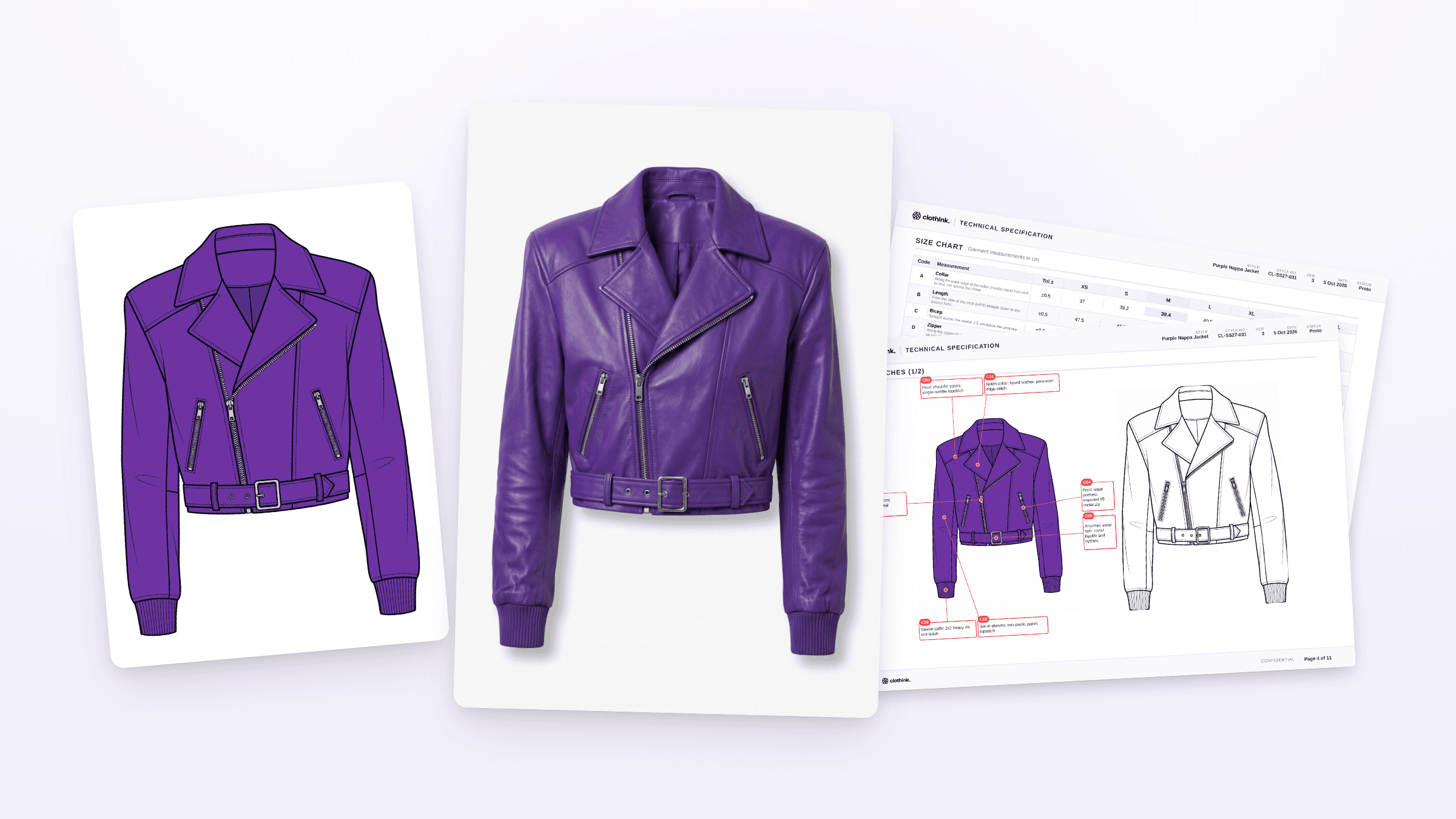
We started with a written description of a purple leather jacket.
From that brief, clothink drew the sketches and technical flats, made photoreal mockups and drafted a tech pack, all in the same workspace. We then reviewed the pack the way a leather factory would read it, tightened the leather and hardware specifications, and exported the 13-page version shown here.
This post follows the jacket through each stage, so you can see how one design carries from an idea to a document a factory can quote from.
Disclosure: clothink publishes this post. The jacket is an illustrative design, made in a clothink demo workspace in October 2026. Every picture is an AI-generated output, not a photograph, and the jacket hasn't been sampled.
The brief
We picked a leather jacket because it's full of details a picture can't settle: how thick the leather is, which hardware fits which strap, and what holds a big shoulder in shape. This was the brief:
“Womenswear SS27 pilot jacket in electric purple lambskin nappa leather: exaggerated strong extended shoulders, boxy body cropped at the waist, oversized notch collar with wide lapels, off-centre silver metal zip, two near-vertical zip pockets at the waist, self-fabric belt at the hem with a square silver buckle, knit rib cuffs in matching purple.”
From a written brief to sketches and flats
From that brief, clothink drew a coloured sketch. We then generated a matching back view and turned both into black-and-white technical flats, the clean line drawings a factory works from.

Everything after this point follows the approved drawing: near-vertical zip pockets at the waist, a belt at the hem and rib cuffs. If you want to change a detail like that, Precise edit lets you tap it, say what to change and compare before and after, without redrawing the rest of the jacket.
Photoreal mockups
Next, the sketches became photoreal mockups: the jacket on a model in a rainy street, a product shot and a back view, plus close-ups of the collar, the buckle and the cuff.

The off-centre zip, the belt and buckle, the waist pockets and the rib cuffs agree across the front, the back and the close-ups. What a mockup can't tell you is how leather of a given thickness will hang or how the jacket will fit. Only a physical sample shows that. Our guide to the AI fashion mockup generator covers this step in more depth.
Drafting the tech pack from the same design
In clothink, a style keeps a garment's sketches, mockups and tech pack together, so the pack starts from the drawing you approved rather than a fresh upload. We started a tech pack from the mockup and sketches and ran Auto-Complete. In one run it drafted:
- Materials and the bill of materials: the leather shell, rib cuffs, a viscose twill lining and cotton pocket bags, plus the zips, buckle, eyelets, threads, labels and packaging.
- A size chart: graded from XS to 3XL, each point of measure with a tolerance.
- How to Measure: each point drawn on the front and back flats.
- Construction notes and call outs: notes from the collar to the belt, with numbered call outs pinned to the sketch.
Every section stays editable. For how each section is drafted, see what an AI tech pack is.

Reviewing it for a leather factory
Auto-Complete gave us a complete first draft. Before export we reviewed it the way a leather factory would read it, as you should with any first draft, whoever writes it. For a leather jacket, these are the parts that decide whether a factory can quote and cut it.
The leather is specified by thickness, not weight
Fabric is bought by weight. Leather is bought by area and specified by thickness. The pack now gives full-grain lambskin nappa at 0.7 mm, plus or minus 0.1 mm, with a semi-aniline finish and a selection grade for the visible panels. The tannage is still to confirm with the tannery. It names a signed-off physical swatch for each colourway as the colour standard, because leather can't be matched to a screen colour. The rib and lining are lab-dipped against that swatch.
It also says how to cut: shade-sort the skins, cut every panel of one jacket from one dye lot, and cut left and right pairs from the same or neighbouring skins, with the best grain on the fronts, collar and belt. Without that, a jacket can come back with two fronts that don't quite match.
The hardware fits together
The belt is 4.5 cm wide, so the buckle has to clear it. The pack specifies a 45 mm square buckle with at least 46 mm inside, to be confirmed on the physical buckle with the actual belt, because a nominal buckle size doesn't tell you the real clearance. That's one place the first draft needed a change: it had listed a 40 mm buckle.
The front zip is ordered per size to match the size chart, from 43.5 cm in XS to 49.5 cm in 3XL, and both zips carry the right tape colour for each of the three colourways.

The structure behind the look
Exaggerated, extended shoulders don't hold in soft lambskin on their own, so the pack adds shoulder pads and a sleeve head roll. It adds a low-temperature leather fusible for the collar and facings, and stay tape on the edges that stretch, such as the shoulders, neckline and zip edge.
Leather is handled differently from cloth, so the notes say so. Seams are opened with adhesive and flattened with a hammer or roller rather than pressed with steam, and visible topstitching isn't back-tacked.
Every measurement has a defined path
The size chart now has 18 points of measure, including belt length, lapel width and collar height. Each one says where the tape goes. The collar, for example, is measured along its outer edge with the collar laid flat, from one collar point round the back neck to the other. Treat the values as starting points for the first fit sample, not final sizing.
What's still open
This is a prototype pack, built to get a first sample and a quote. Some decisions rightly stay open until then:
- the tannery, the leather article and the signed-off swatch for each colourway
- the physical buckle, zips and eyelets, checked together with the belt
- lab dips for the rib and lining
- the pattern: clothink doesn't make sewing patterns, so a pattern cutter or your factory does
- the fit sample, which confirms the length, the sleeve with the extended shoulder and every value in the size chart
- consumption and cost, which come from the factory's marker and quote
Why one workspace matters
The sketch, the mockups and the tech pack in this post are one style. The drawing we approved is the drawing the pack was built from, and when a detail changes, the pack is in the same place. In most set-ups those stages live in an image tool, a spreadsheet and an email thread, and each handover is a chance for the jacket to change by accident.
If you're comparing tools, see our guides to the best AI fashion design tools and the best tech pack software. Before you send your own pack, our guide to writing a tech pack factories will quote from is a useful checklist.
What does it cost?
- Free plan: no card, 10 starter tokens, and up to 3 active tech packs you can make and edit. A sketch or a standard mockup usually costs 1 token. Your first Auto-Complete run is free, then it's 3 tokens a run.
- Exporting: to download a pack as a PDF and Excel file, unlock that pack once for £15, or choose a paid plan.
- Paid plans: from £19 a month, with monthly tokens, every export and Auto-Complete included. See clothink pricing.
Take your own design from sketch to tech pack
Start on the Free plan with no card. Make and edit up to 3 active tech packs, then unlock one for £15 or choose a plan when you're ready to export.
Frequently asked questions
Can AI create a tech pack from an existing clothing sketch?
Yes, as a first draft. In clothink you can upload your own sketch or a photo and run Auto-Complete on it. For a photo, letting clothink draw front and back flats first gives more accurate measurements. Details an image can't show, such as inside seams, still need checking.
Can I edit measurements and construction details after the AI drafts them?
Yes. Every section of a clothink tech pack stays editable: you can change bill of materials rows, size chart values and construction notes, and drag How to Measure lines to where they should be.
Is this jacket's tech pack ready for production?
It's ready for a first sample and a quote. It isn't approved for bulk: the leather swatch, trims, lab dips and fit sample are still open, as they are for any prototype pack.
Does AI fashion design software make sewing patterns?
clothink doesn't. It drafts the tech pack that a pattern cutter or factory works from, and it doesn't simulate fit or drape. Pattern-based 3D tools such as CLO are built for that.
Can I make a tech pack for free?
Yes. On clothink's Free plan you can make and edit up to 3 active tech packs with no card. Downloading the PDF and Excel files needs a £15 unlock for that pack or a paid plan.
What file formats does the tech pack export to?
A PDF for the factory and an Excel workbook laid out like the PDF, with the sketches, call outs and size chart included.