Fashion designclothink
How to Design a Clothing Collection: A Step-by-Step Guide Using AI
- Product development
- Startup brands
- AI design
Designing six garments is easy. Designing six garments that belong together, suit the same customer and can be made at a profit is a different job.
AI has made the first part much faster. You can describe a garment and see it drawn, coloured and on a model without picking up a pencil. The second part still depends on decisions: who the collection is for, which pieces earn their place, how many colours you can afford to stock and what a factory needs to make it.
We work on both sides of that line. clothink is built so that the journey from first sketch to factory sits in one workspace. This guide follows one real six-piece denim capsule through that journey. Every sketch, mockup, lookbook page and tech pack page in it was made in clothink for this article, and at each step we explain what the AI did, what we changed and why.
How do you design a clothing collection?
To design a clothing collection, work through eight steps in order:
- Define the customer and the concept. Who the collection is for and what makes it distinctive.
- Build a range plan. Which garments, in which colours, at which prices, and why each one exists.
- Set the colour story and design rules. A controlled palette and the few details every piece shares.
- Design the hero garment first, then the rest. Draw an initial line-up, refine the hero one detail at a time, then bring the other pieces into line with it.
- Choose fabrics, finishes and trims early. Fewer fabric families, fewer finishes and an eye on minimum order quantities.
- See the collection worn. Product mockups, complete outfits and a lookbook to judge the range as a wardrobe.
- Write a tech pack for every style. Measurements, materials and construction a factory can sample and quote from.
- Cost, sample and edit. Check the numbers, test the garments physically and cut what does not earn its place.
AI does most of its work in steps 3, 4, 6 and 7. In steps 1 and 2 it can suggest, but the decisions are yours. Step 5 needs suppliers, and step 8 needs real fabric and a real factory.
In this guide
- The collection: Indigo Hour
- Step 1: Define the customer and the concept
- Step 2: Build a range plan
- Step 3: Set the colour story and design rules
- Step 4: Design the hero garment first, then the rest
- Step 5: Choose fabrics, finishes and trims early
- Step 6: See the collection worn
- Step 7: Write a tech pack for every style
- Step 8: Cost, sample and edit
- What the AI did, and what we decided
- Frequently asked questions
The collection: Indigo Hour

Indigo Hour is a six-piece womenswear denim capsule: sculpted shapes in rigid denim, clean finishes, ecru topstitching and two washes, a dark raw indigo and a soft lilac. It is for people who buy fewer, better pieces and want denim that goes further than a basic blue jean.
| Style | Garment | Its job in the collection |
|---|---|---|
| 01 | Barrel-leg jean | The hero. Its curved leg sets the shape every other piece echoes |
| 02 | Cropped collarless jacket | The statement piece, cut to sit at the jean's high waist |
| 03 | Denim waistcoat | A top in its own right, or a layer over the T-shirt |
| 04 | Denim maxi skirt | The second bottom, for customers who will not wear a barrel leg |
| 05 | Oversized chambray shirt | The lighter layer that softens head-to-toe denim |
| 06 | Fitted rib T-shirt | The entry point, and the quiet piece under everything else |
The aim is six different products that clearly come from one brand, not six variations of one garment.
These are development visuals for a worked example, not photographs of physical samples. The prices and fabric weights below are planning targets, not quotes.
Step 1: Define the customer and the concept
Start with the customer, not the garments. The customer decides almost everything that follows: the fit, the fabric, the colours, the price and how the collection is photographed. A denim range for vintage collectors and one for first-time customers might both include a jean, but they would not share a specification.
Here is the brief for Indigo Hour:
| Element | Our brief |
|---|---|
| Customer | Women who buy fewer, better pieces and want denim beyond a basic blue jean |
| Style | Contemporary denim: sculpted shapes, clean finishes, no distressing, no visible branding |
| Season | Spring 2027 |
| Range | Six pieces: four in rigid denim, a chambray shirt and a jersey T-shirt |
| Colour direction | Two denim washes, a lighter chambray and an ecru accent |
| Materials | Rigid cotton denim, cotton chambray and cotton rib jersey |
| Price position | Contemporary, with one clear entry piece and one statement piece |
That is enough to steer the design work without deciding every detail in advance.
Turn the brief into a line-up

In clothink, Plan a collection turns a written brief, plus up to six moodboard pictures if you have them, into a proposed line-up of pieces. Brainstorming the line-up is free. You can edit, park or remove any piece, and nothing is drawn until you press Start. The brief then carries the collection through a palette, sketches, any prints and mockups. This is the brief we wrote:
Develop a six-piece contemporary denim capsule for a small independent womenswear brand. The customer buys fewer, better pieces and wants denim that goes beyond a basic blue jean. Use sculpted, modern shapes in rigid denim, clean finishes with no distressing, ecru topstitching, silver hardware and no visible branding. Two washes: a dark raw indigo and a soft lilac. Include a barrel-leg jean, a cropped collarless jacket, a denim waistcoat, a denim maxi skirt, an oversized chambray shirt and a fitted rib T-shirt.
The proposed line-up is a starting point. Read it the way a buyer would: does each piece have a reason to exist, and would the customer in the brief actually wear all of them?
The brainstorm came back with the six garments we asked for, but not our design rules: the jacket had no curve at all and every button was just "metal". Before pressing Start we rewrote four of the six descriptions so each piece carried the jean's curve, ecru topstitching and silver hardware. That cost nothing, because nothing is drawn until you start.
Step 2: Build a range plan
A collection is a set of products, not a set of sketches, so it needs a plan. In fashion businesses this is called range planning: one view of every style, its job, its colours, its fabric and its price. For a small brand, a spreadsheet is enough.
This is the range plan for Indigo Hour:
| Style | Role | Colours | Fabric direction | Target retail |
|---|---|---|---|---|
| 01 Barrel-leg jean | Hero | Raw Indigo, Lilac Wash | 13.5 oz rigid cotton denim | £110 |
| 02 Cropped jacket | Statement | Raw Indigo, Lilac Wash | 13.5 oz rigid cotton denim | £130 |
| 03 Denim waistcoat | Core top | Raw Indigo | 13.5 oz rigid cotton denim | £80 |
| 04 Denim maxi skirt | Core bottom | Raw Indigo | 13.5 oz rigid cotton denim | £95 |
| 05 Chambray shirt | Layering | Pale Indigo | 5 oz cotton chambray | £65 |
| 06 Rib T-shirt | Entry | Lilac, Raw Indigo | Cotton rib jersey | £35 |
The retail targets are illustrative, to show how a price ladder works. They are not costings or pricing advice.
Give every price a reason

A good range has a clear entry point and a clear hero, and every price in between is explained by fabric, construction or both. Here the £35 rib T-shirt is the piece a new customer can buy without much thought. The £130 jacket is the most expensive piece because it carries the most construction and sits at the top of the range.
The hero is not the most expensive piece, and that is deliberate. In denim, the jean is what customers come back for once the fit is right, so it gets the most development time, not the highest price. The jacket sets the ceiling, which makes £110 for the jean feel considered rather than steep.
Styles, colourways and SKUs are not the same thing

Six styles sounds small, but every colour multiplies the stock you have to sample, buy and sell, and every size multiplies it again. Denim adds another multiplier: jeans are sold by waist and by length.
Our assumptions: the jean is sold by waist, in six sizes (24 to 34) and two possible lengths; the other five styles come in five sizes each (XS to XL). If every style came in two colours, the jean would be 6 waists × 2 lengths × 2 colours = 24 SKUs and the other five styles 5 sizes × 2 colours = 10 each, or 50. Our six designs would become 12 style-colours and 74 SKUs. We made two edits:
- A second colour only where it sells. The jean, the jacket and the T-shirt come in two colours; the other three in one. That gives 9 style-colours and 59 SKUs.
- One length for the jean at launch. A single ankle-length inside leg, with a second length added once sales show it is needed. That halves the jean to 12 SKUs and takes the plan to 47 SKUs, before a single sample is cut.
Decide what you would launch if the budget shrank
Rank the styles by priority before you design them, so you know what to cut later. Ours:
- Jean and jacket. They share a cloth and both washes, define the look and are the hardest to get right, so they are sampled first.
- Rib T-shirt. The entry price, and the simplest garment to develop.
- Waistcoat. It uses the same denim and turns the jean into a full outfit on its own.
- Maxi skirt and chambray shirt. Useful, but the first to wait.
If the budget only covers four styles, the jean, jacket, T-shirt and waistcoat still make a complete wardrobe. A four-piece collection you can afford to launch beats a twelve-piece range you cannot.
Step 3: Set the colour story and design rules
With the range planned, give it a visual identity. A moodboard helps if it helps you decide things: vintage workwear denim can supply topstitching and hardware without the heavy distressing that would date the range.
A palette with a job for every colour

Indigo Hour uses four colour families, each with one job. The lilac reaches the clothes by two different routes, so the table separates them:
| Colour | Role | Used on | How it is made |
|---|---|---|---|
| Raw Indigo | Core dark colour | Jean, jacket, waistcoat, skirt, T-shirt | Dark indigo denim; dyed jersey on the T-shirt |
| Lilac Wash | The fashion colour | Jean and jacket | A denim finish: garment washing and tinting |
| Lilac | Matching jersey | T-shirt | Dyed jersey, matched to Lilac Wash by lab dip |
| Pale Indigo | Light layer | Chambray shirt | Dyed cloth |
| Ecru | Accent | Topstitching thread only | Dyed thread |
The point of a denim collection is that the wash is the colour story. Because five styles come in Raw Indigo, almost any top works with almost any bottom, which is what a customer buying two pieces wants. Lilac Wash is the reason to look twice, and the lilac T-shirt picks it up without being the same process.
The collection brief generated a named palette as its first stage. We adjusted it to these colours and their jobs, then used that one palette on every sketch and mockup instead of letting each garment invent its own.
On-screen colours are references, not production standards. Washes are agreed with your laundry through physical wash standards, and dyed colours with your fabric supplier through lab dips.
Write down the design rules
Before sketching, we wrote four rules every denim piece had to follow. They are what make six different products read as one collection:
- Ecru topstitching. Double-needle ecru thread on every seam that shows.
- One curve. The barrel leg's curved side seam returns as curved panel seams on the jacket, waistcoat and skirt.
- Silver hardware only. Silver shank buttons and rivets, no copper or brass.
- A clean finish. No rips, whiskering, back-pocket stitch motifs or visible branding. The design language is the branding.
Step 4: Design the hero garment first, then the rest
Start with the garment that defines the collection. Get the jean right and the other five have something to follow.
In practice the sequence is: pressing Start in the collection brief drew an initial line-up of all six pieces; we then refined the jean as the hero, one detail at a time; and once it was approved we brought the other five into line with it. Setting that approval point matters. When another variation takes seconds, it is easy to keep generating instead of deciding.
In clothink you can start from a written description, add up to three pictures as style inspiration, or upload a photo of a rough drawing or an existing garment to convert into a sketch. Each design can be drawn as a coloured sketch, a flat sketch or a fashion sketch, and each does a different job: a fashion sketch explores proportion and attitude, a coloured sketch shows colour and fabric, and a flat sketch shows the construction a factory reads.
This was the prompt for the jean:
A high-rise barrel-leg jean in rigid raw indigo denim. Fitted through the waist and hip; the leg curves out through the thigh and knee and tapers back to an ankle-length hem. Curved side seams, five-pocket construction with scooped front pockets, two plain back patch pockets, double-needle ecru topstitching, a silver shank button and silver rivets. Clean and contemporary. No rips, distressing, whiskering, embroidery or back-pocket stitching.
Notice the description of the leg and the last sentence. Fashion words are loose: "barrel", "balloon" and "horseshoe" are used for similar legs, and "raw" can mean unwashed denim or a frayed hem. Describing the shape you want, and saying what should not be there, saves a round of corrections.
Change one detail at a time
The first jean had the shape we wanted: the barrel leg, the curved seams and the five pockets. Its wash was paler than the Raw Indigo in our palette, and colour is the cheapest thing to change, so we kept the drawing and changed only that.
Precise edit lets you outline part of a drawing and describe the change you want, and only that area is redrawn. A colour-only edit with the whole jean outlined turned it Raw Indigo without moving a seam, and the same edit corrected the waistcoat and skirt, which the brief had drawn in lilac and ecru.
Once a direction is approved, you want to protect it, not regenerate it. With the Raw Indigo jean approved, we made its Lilac Wash colourway from the same design rather than drawing a new jean.
Carry the design language across the range

With the jean approved, we brought the other five into line with the four rules from step 3:
- The cropped jacket takes the jean's curve as curved front panel seams and ends at the jean's high waist so the two meet.
- The waistcoat carries the curved panel seams down to a shaped front hem, so it works as a top on its own.
- The maxi skirt borrows the jean's five-pocket construction and curved panels, with a front slit so it can be walked in.
- The chambray shirt is the lighter piece: the same topstitching in a softer cloth, oversized so it layers over the T-shirt.
- The rib T-shirt is the one quiet piece. It carries the palette, not the details, and is fitted so it tucks into the jean and the skirt.
The test is simple: put all six side by side. If one looks as if it came from another brand, it is not finished.
If drawing is the part holding you back, our guide to designing clothes when you cannot draw goes deeper on starting from words and photos.
Try it on your own idea: you can start a collection brief and your first sketches on clothink's Free plan. Start free.
Step 5: Choose fabrics, finishes and trims early
AI can draw a garment in any fabric you can imagine. That does not mean the fabric exists at your price and quantity, or behaves the way the picture suggests, so decide early, while the designs can still change.
Plan fabric families, not one fabric per style
Instead of six fabrics, Indigo Hour uses three families:
| Styles | Fabric direction | Why |
|---|---|---|
| Jean, jacket, waistcoat, skirt | 13.5 oz rigid cotton denim | One base cloth for all four denim pieces |
| Chambray shirt | 5 oz cotton chambray | Light enough to layer over the T-shirt |
| Rib T-shirt | Cotton rib jersey, about 200 gsm | Holds a close fit and tucks in cleanly |
These are development targets, not approved specifications: the brief you take to a mill. If ounces and gsm are new to you, our guide to fabric weight explains both. Sharing a cloth can simplify sourcing and colour matching, but it does not automatically make anything cheaper, and a maxi skirt may need more drape than the denim that suits the jean.
In denim, the colour is a finish
For Indigo Hour, the planned lilac denim finish is applied through garment washing and tinting after sewing, subject to laundry trials. That makes the laundry a second supplier, with its own price per garment, minimums, lead time and approval: a physical wash standard you sign off before production.
Every wash you add is another standard to approve, another minimum to meet and another chance for two batches to come out differently. That is why Indigo Hour has two washes, not four, and why Lilac Wash goes only on the two denim styles most likely to sell, the jean and the jacket.
The lilac T-shirt is a different job. It uses separately dyed jersey, colour-matched to the approved denim finish through lab dips. It shares the colour on screen, not the production route, and it needs its own dye minimum and approval.
Count the minimums before you add a colour
A six-piece collection can carry far more minimum order quantities than six: a factory may set one per style or colour, a mill per fabric, a laundry per wash, and custom trims such as branded buttons or woven labels often carry their own.
Spread a small order across too many fabrics, washes and custom trims, and the cost per garment climbs quickly. That is why the accent lives only in the thread and the hardware is plain silver: standard trims, not custom orders. Designing with manufacturing in mind tells you which decisions cost money, so you can spend it where the customer will notice.
Step 6: See the collection worn
A flat shows construction. It does not show whether six garments work as a wardrobe. That is what photoreal mockups are for.
Product mockups, all lit the same way

We turned each approved sketch into a photoreal mockup with the same studio background and light, so the six could be compared directly, then checked each against its sketch:
- Is the leg still a barrel, with the curve where we approved it?
- Are the back pockets still plain?
- Is the hardware still silver?
- Do the four denim pieces look like the same cloth, and do both washes look like the same jean?
AI can drift on colour from one garment to the next: our first set of mockups showed the same raw indigo denim in visibly different shades. clothink has a fix. Upload a photo of the fabric, or pick a saved one, and attach the same swatch to every mockup. We remade the four denim pieces with one Raw Indigo swatch, and the cloth now matches. The swatch covers the whole garment, at the normal mockup price, and cannot be combined with an all-over print.
For the jean we also added the back, the side and a close-up of the back pocket, because those are the details a buyer looks at first.
A mockup helps you judge appearance and proportion. It does not prove how a garment will fit or drape when it is made.
Build outfits to test the range as a wardrobe

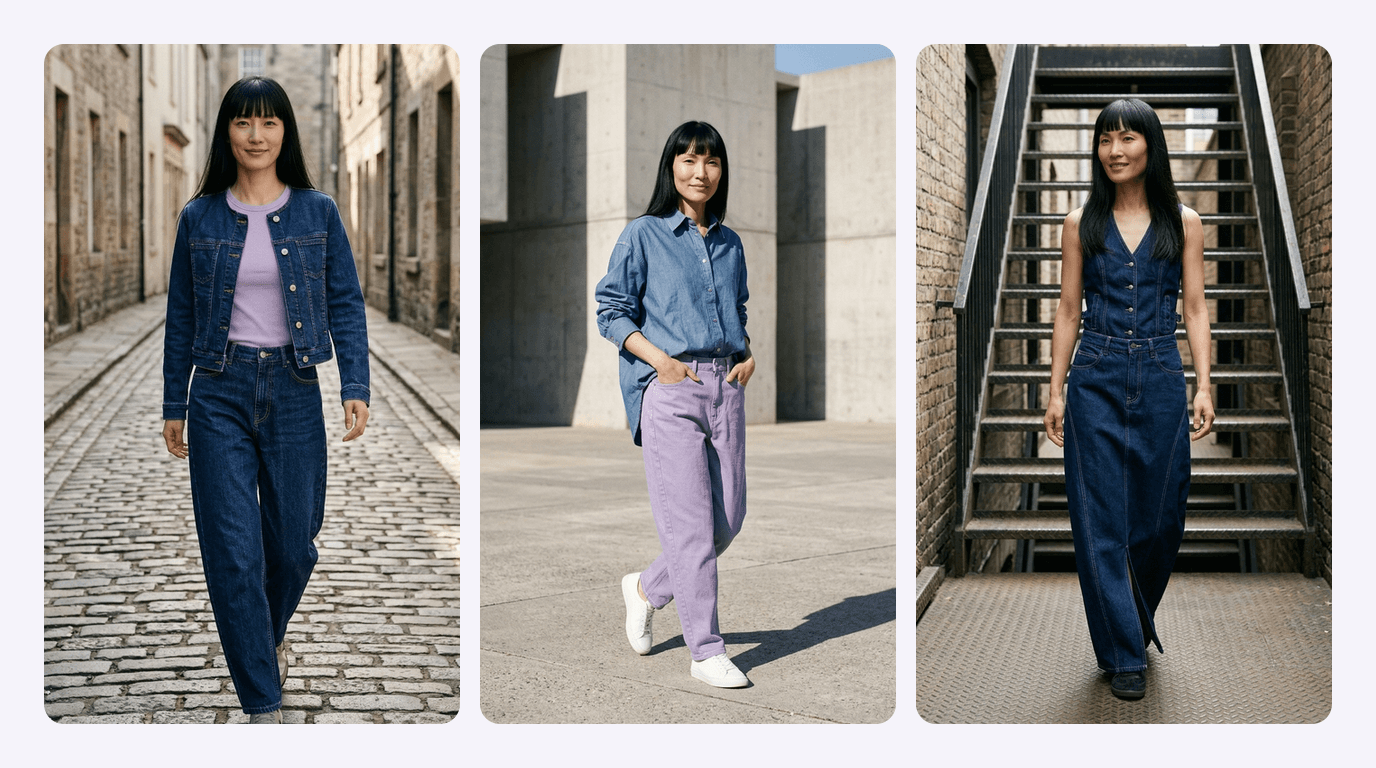
The most useful test of a collection is seeing the pieces worn together. With outfit mockups in clothink, you combine two to five garments from your library into one on-model picture. We built three looks on the same Model so the comparison is fair:
| Look | Garments |
|---|---|
| Look 01 | Raw Indigo cropped jacket, Lilac rib T-shirt, Raw Indigo barrel jean |
| Look 02 | Pale Indigo chambray shirt, Lilac Wash barrel jean |
| Look 03 | Raw Indigo waistcoat worn as a top, Raw Indigo maxi skirt |
This is where a range shows its gaps: a jacket that ends at the wrong point for the jean's rise, head-to-toe Raw Indigo that reads as a uniform, or a lilac that looks washed out next to the chambray. Finding that out on screen costs far less than finding it out in a sample room.
Look 02 settled the question we were most worried about: next to the chambray, Lilac Wash reads as a fashion colour rather than faded denim. Look 03 was the surprise. Tucked into the high waist of the skirt, the waistcoat turns two pieces of Raw Indigo into one long column, so head-to-toe denim looks deliberate rather than like a uniform.
Outfit mockups and saving your own Models are part of clothink's paid plans; the four built-in Models are free on every plan.
Pull it together as a lookbook

A lookbook tells the story of a collection to buyers, stockists or customers. Its job is the concept and the clothes, not the measurements. Every collection in clothink can be downloaded as a lookbook PDF with a cover, a colour and mood page, a page for each design, the looks and the full line-up, and each section can be switched on or off. We kept the cover, the colour story, the six designs, the three looks and the line-up, and left out the artwork page because the collection has no prints. If you are approaching stores, you will also need a line sheet with style codes, colours, sizes, prices and delivery dates.
Label every picture honestly: mockups of garments that have not been made should never be presented as photographs of finished samples.
Step 7: Write a tech pack for every style
This step turns a collection of ideas into something a factory can make. A lookbook sells the idea; a tech pack tells the factory how to build it. You will usually have one lookbook for the collection and a tech pack for every style.
For the jean, the first version of the pack covered:
| Section | What it says for the jean |
|---|---|
| Overview | Style code, fit, size range (six waists, one length) and both washes |
| Flats with call outs | Front and back, with numbered notes on the waistband, pockets, curved side seam, rivets and hem |
| Materials and colour | The denim by composition, weight and finish; both washes |
| Bill of materials | Shell denim, pocketing, shank button, rivets, ecru thread and labels |
| Size chart | Waist, hip, front and back rise, thigh, knee, leg opening and inside leg, graded with tolerances |
| How to Measure | Where each measurement is taken, drawn on the flat |
| Construction notes | Seam types, the curved side seam, topstitching, rivet placement and hem |
In clothink, the tech pack is built from the jean's own sketch and mockup. Auto-Complete drafts the materials, bill of materials, size chart, How to Measure and construction notes, and every section comes back as a proposal for you to review before it is accepted. You then export the pack as a PDF and an Excel workbook for the factory.
The jean pack, page by page

Six pages from the jean's exported PDF, shown small: the overview and materials, flats with numbered call outs, size chart, How to Measure, bill of materials and construction notes.
Review it like a technical designer
A drafted pack is a starting point. The AI can propose a weight for rigid denim, but it cannot tell you whether your mill stocks one or how much it shrinks. Rigid denim can shrink noticeably in the wash, so the pattern is cut larger to allow for it, and the size chart has to say whether each measurement is taken before or after washing.
Our jean shows how much the review matters. Auto-Complete drafted a full 14-size chart on a standard US waist run, 28 to 54, graded from a size 32. That is a sensible default for jeans, but not our customer, so we switched the chart to our six women's waists, 24 to 34, with 28 as the base size, and clothink regraded every measurement. clothink's pre-export check then flagged the rise, which grew 1 cm a size. Grade rules vary with the garment, silhouette, fabric and sizing system, so there is no universal figure; we chose 0.75 cm as our provisional rise grade, pending technical and fit review. A smaller fix came from our own design rules: the bill of materials proposed copper-coloured rivets, and we changed them to silver.
The 66 cm inside leg also stayed, but as a planning figure. The sketch shows the intended ankle-length proportion; it cannot validate a measurement. That number has to be tied to the customer's height and the fit brief, then confirmed in sampling.
A pack is factory-ready after review, not before. For the detail a finished pack carries, see our complete hoodie tech pack example, and for what a factory needs to price your style, read how to write a tech pack factories will actually quote from.
Build the pack for your own hero piece: on the Free plan you can create and edit up to three tech packs, and your first Auto-Complete is free. Start free.
Step 8: Cost, sample and edit
By now you can have six convincing garments, consistent mockups and a lookbook. The question that matters most is whether you can afford to make it, and whether it works in real fabric.
Check the numbers before you sample
The cost of sewing a garment is rarely what surprises first-time brands. These usually are:
- Minimums. Our shared denim only helps if its quantities meet the mill's minimum, and Lilac Wash only works if the laundry's minimum fits the order. The lilac jersey has its own dye minimum.
- Washing. Raw Indigo needs little washing; Lilac Wash needs washing down and tinting, which adds cost to every garment that carries it.
- Development and sampling. Every style needs its own pattern and samples, even when it shares a fabric. Expect fit samples and possibly a size set or pre-production sample.
- The price build-up. Work backwards from the price your customer will pay: manufacturing, washing, freight, duty, packaging, returns, selling fees and the margin you or your stockists need.
- Stock. Our edited plan is still 47 SKUs, and 12 of them are one jean. That is inventory you commit to before you know what sells.
clothink can do the arithmetic. The tech pack's Costing step takes a unit price and consumption for each bill of materials row, then cut and make, overheads, duty and freight and your wholesale and retail prices, and calculates the cost and margin. The numbers are yours: the AI does not draft prices. The costing page stays out of the PDF unless you add it, so you choose what a factory sees.
When you ask for quotes, send each style's tech pack with the expected quantities, size range, colour and wash split, target timing and any testing you need, and ask the factory to state the assumptions behind its price. Our guide to clothing manufacturing terms explains the words you will meet on the way.
Sample, then update the pack
A garment that looks balanced in a mockup can feel quite different in the hand. The barrel leg might lose its curve in rigid denim, the maxi skirt might be too stiff in 13.5 oz, or Lilac Wash might come back greyer than it looked on screen. You only find these things in a physical sample. Record the changes, update the tech pack and keep track of which version was approved. In clothink you create a revision of the pack with a note of what changed, and its revision history can be filtered by stage (proto, pre-production and production). Your team can identify the current revision, then export it and send it to the factory with its revision number and change notes.
Before production, check that the latest pack matches the approved sample, fabric, wash, trims, measurements and construction, so the range can be made the same way every time.
What the AI did, and what we decided

This is the honest split from building Indigo Hour:
| Stage | What the AI drafted | What we decided |
|---|---|---|
| Concept | A proposed line-up from our brief | The customer, the six pieces and what to leave out |
| Range plan | A starting line-up to plan from | Colours per style, prices, priorities, the jean's sizes and the SKU count |
| Colour | A named palette from our description | Each colour's job, and only two denim washes |
| Design | Sketches, flats, colourways and targeted edits | The design rules, what was wrong and when a design was approved |
| Visuals | Product mockups, outfits and the lookbook | Which looks to build, and what they told us about the range |
| Tech packs | First drafts of every section | Every number and material, through review, including shrinkage |
| Costing and sampling | Nothing; costing is calculated from our numbers | Everything |
AI took most of the drawing, rendering and document drafting off our hands. It did not choose the customer, edit the range, set a price or approve a sample, and it should not. Deciding what to leave out is half of collection design.
Frequently asked questions
How many pieces should a first clothing collection have?
There is no fixed number. A first capsule is often four to eight styles. The right size depends on your budget, your customer, your manufacturers' minimums and where you will sell. A small collection with a clear hero and an entry piece is easier to develop, afford and sell than a large one.
What is a range plan in fashion?
A range plan is one view of every style in a collection: its role, colours, fabric, target price and priority. It shows how many style-colours and SKUs the collection really contains, and where the gaps and overlaps are, before any money goes into samples.
How do you make a fashion collection look cohesive?
Start from one customer and one concept, then use a controlled palette, a few recurring details and shared fabric families. Review the garments together as outfits, not one at a time. If one piece looks as if it came from a different brand, change it or cut it.
Can I design a clothing collection with AI for free?
You can start. clothink's Free plan includes 10 starter tokens that never expire, and brainstorming a collection line-up is free. Tokens pay for sketches and mockups, and you can create and edit up to three tech packs, with your first Auto-Complete free. Outfit mockups and saving your own Models require a paid plan. Tech pack exports are included on paid plans, or you can unlock a single pack for £15.
Do I need to know how to draw to design a clothing collection?
No. You can start from a written description, a reference photo or a rough sketch. You still need to know what you want each garment to be and to review every result carefully.
Can AI make tech packs for a whole collection?
AI can draft a tech pack for each style from its sketches and mockups. Each style still needs its own measurements, materials and construction checked by you, and updated after sampling, before production.
What is the difference between a collection and a capsule collection?
A collection is a coordinated range built around a season, customer or concept, and can be large. A capsule is a smaller, focused collection of versatile pieces designed to be worn together in many combinations.
How long does it take to design a clothing collection?
The concept, sketches and mockups can come together quickly with AI. Physical development takes longer: fabric sourcing, washing, pattern making, fit samples, corrections, costing and production all have their own lead times, which depend on the number of styles, their complexity and your suppliers.
Start your collection in clothink
clothink is an AI product development workspace for apparel, from first sketch to factory. Start from a collection brief, build your palette and sketches, see the range on photoreal models and draft a tech pack for every style, all connected in one place. The Free plan needs no card, includes 10 starter tokens and lets you create and edit up to three tech packs. Exporting a pack needs a paid plan or a £15 one-off unlock. Start free at clothink.ai.