· clothink
50 Fashion Terms You Need to Know Before Talking to a Clothing Factory
- Product development
- Manufacturing
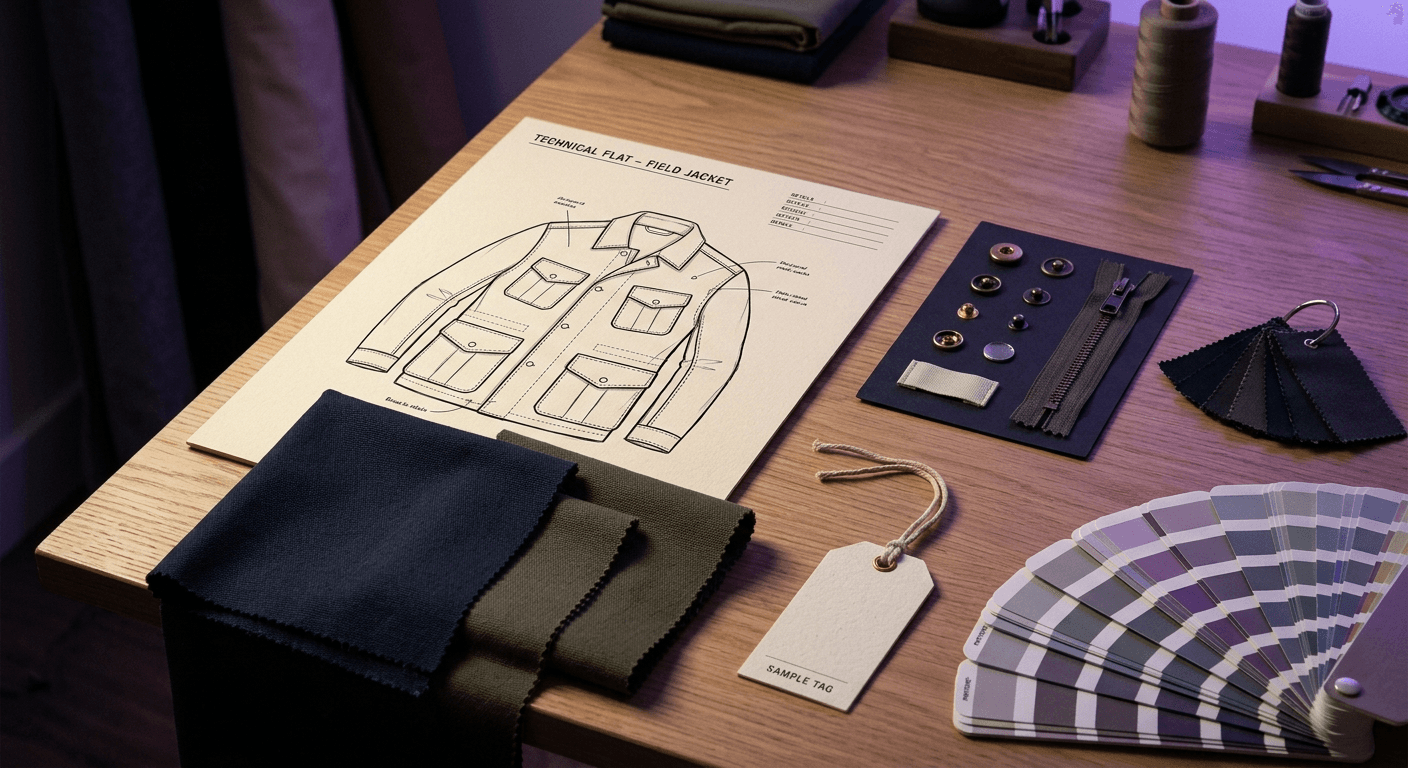
A factory asks for your BOM. The mill has a dye MOQ. Your lab dip is approved, but the bulk shade band is not. Then somebody asks whether the PP can be sealed.
If you are developing your first clothing product, the terminology can make a fairly straightforward conversation sound much more complicated than it is.
You do not need to speak factory jargon. You do need to understand what each term means for the product, price or decision you are being asked to make.
This is not an exhaustive fashion dictionary. We have left out plenty of terms that are either self-explanatory or too specialist to matter to most new brands. These are 50 worth knowing.
One caveat: terminology is not perfectly standardised across the apparel industry. Different brands, factories and countries sometimes use slightly different names for the same thing. If you are unsure, ask what somebody means. Clarifying a term before production is considerably cheaper than discovering afterwards that you understood it differently.
If you have not yet defined a product at all, settle the concept, target customer and realistic quantities before worrying about most of the factory shorthand below.
In this guide
- Design, fit and technical development
- Fabric and colour
- Trims, branding and setup costs
- Sampling and approvals
- Costing, orders and production
- Quality, testing and compliance
- Shipping and customs
- The 10 terms worth learning first
Design, fit and technical development
1. Tech Pack
The technical definition of the product you want the factory to develop and manufacture.
A tech pack brings together the information needed to make the garment: technical drawings, materials, size charts, trims, colours, construction, branding and other specifications.
A good way to think about it is this:
If the factory cannot find the answer in the product, sample or tech pack, somebody has to guess. The aim is to remove as many of those guesses as possible.
For a full walkthrough of what belongs in a pack, see our guide to what an AI tech pack includes.
2. Technical Flat / CAD
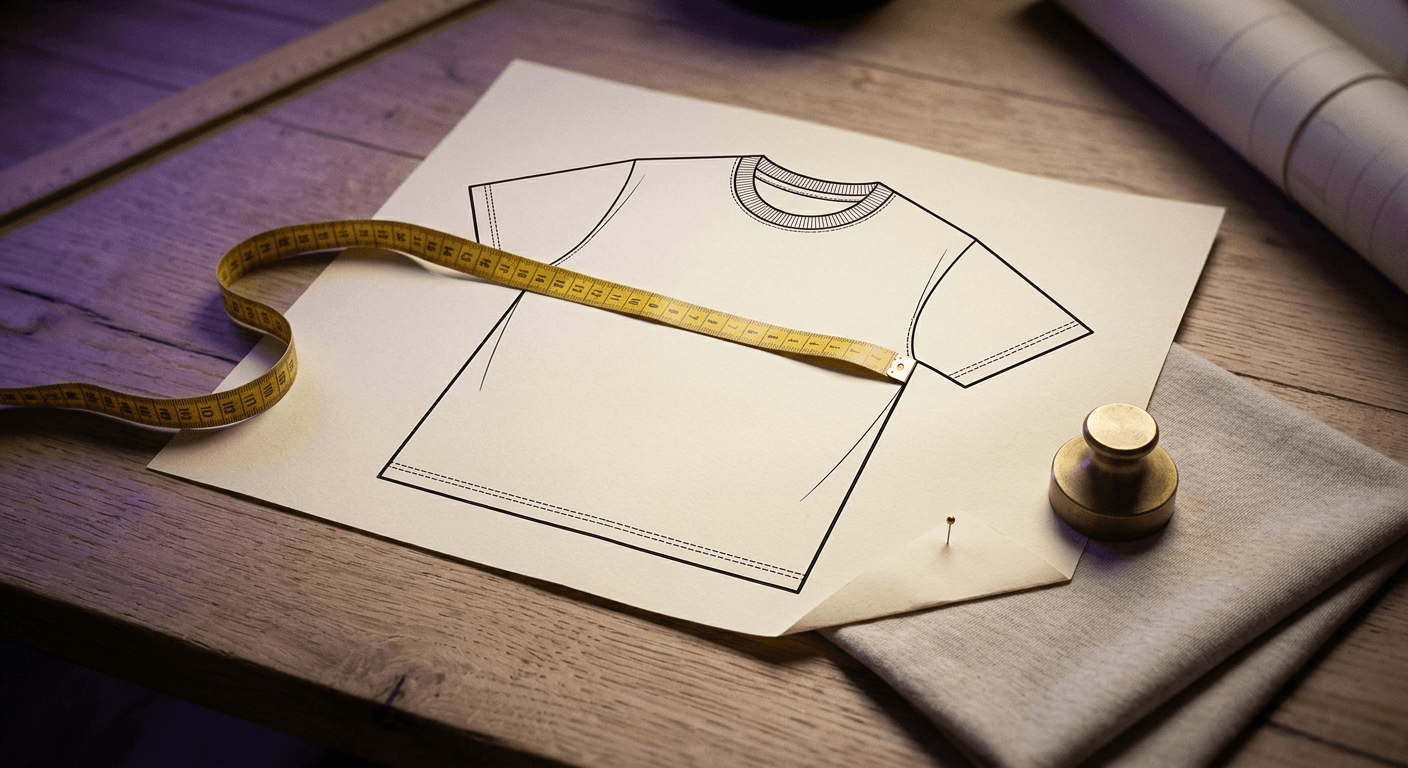
A clean drawing showing the garment without a model, pose or perspective.
Front and back views are standard, with extra detail views added where needed. In apparel, you will often hear these drawings referred to simply as CADs, although CAD technically means computer-aided design more broadly.
A fashion illustration communicates the idea. A technical flat starts defining the product. If you are still at the concept stage, our guide on going from idea to factory-ready walks through how flats fit into early development.
3. Size Chart
The finished garment measurements required across the size range.
A production size chart is different from the customer-facing chart on your website. These are measurements of the garment, not the body wearing it. The size chart tells the factory what each size should physically measure and usually works alongside POM definitions, grading and tolerances.
| POM (cm) | S | M | L | XL |
|---|---|---|---|---|
| Half chest | 55 | 58 | 61 | 64 |
| Body length | 70 | 72 | 74 | 76 |
For a step-by-step guide to building one, see how to build a production size chart.
4. BOM — Bill of Materials
The list of materials and components required to make the product.
A jacket BOM might contain the main fabric, lining, zip, snaps, elastic, drawcord, thread, labels, badges and packaging. The more specific it is, the better.
Black zip leaves questions. 5 mm reverse-coil nylon zip, 68 cm, black, matte puller answers more of them. See also what factories need to quote — the BOM is central to that conversation.
5. POM — Point of Measure
The exact point and method used to measure a garment.
Chest sounds clear until two people measure it differently. A POM might instead say: half chest — measured straight across 2.5 cm below armhole. POMs are often shown with measurement arrows on a technical drawing so the brand, pattern cutter, factory and quality team all measure the product consistently. See how to build a production size chart for the full POM workflow.
6. Pattern
The shaped pieces used to cut the fabric from which the garment is assembled.
A shirt might have separate pattern pieces for the front, back, sleeve, cuff and collar. The technical flat shows how you want the garment to look. The pattern turns that design into the actual shapes required to make it.
7. Block
An established pattern foundation used as the starting point for new products.
Once a brand has a T-shirt fit that works, it does not necessarily rebuild every future T-shirt from zero. An approved block gives the pattern cutter a known starting point and helps a brand develop more consistent fit across products.
8. Ease
The difference between body measurements and finished garment measurements.
Someone with a 100 cm chest does not necessarily need a garment with a 100 cm chest. A relaxed T-shirt might be significantly wider. A close-fitting stretch garment might sit much closer to the body. Ease is one of the reasons two brands can both sell a Medium that fits completely differently. It is not just sizing — it is part of the silhouette.
9. Grading
The process of developing the other sizes from an approved base-size pattern.
Grading is not simply making the whole garment 5% larger for every size. Chest, shoulder, sleeve, body length, rise and other areas can all change by different amounts. The objective is to preserve the intended fit and proportion as the garment moves through the size range. For grade rules, worked examples and how grading relates to the size chart, see how to build a production size chart.
10. Tolerance
The acceptable production variation around a target garment measurement.
If the size chart says half chest: 58 cm ±1 cm, the target is still 58 cm. The tolerance recognises that apparel production naturally produces small dimensional variations. Too wide and you lose control of fit. Too tight and the factory may struggle to achieve it consistently.
Fabric and colour
11. GSM
Grams per square metre: the weight of one square metre of fabric.
A 300 GSM material has more mass per square metre than a 180 GSM material. What GSM does not mean is quality. Two fabrics at exactly the same GSM can feel completely different because of the fibre, yarn, construction, density and finishing. Higher GSM does not automatically mean better fabric.
12. Fabric Construction
How the fabric itself is built.
Examples include:
- single jersey
- French terry
- interlock
- piqué
- twill
- canvas
- ripstop
- fleece
This is why specifying only 100% cotton, 240 GSM still leaves a major question unanswered. 240 GSM what? A cotton jersey and a cotton twill at the same weight behave very differently.
13. Knit vs Woven
Two major families of fabric construction.
Knitted fabrics are formed through interlocking loops and include jersey, rib, interlock and many fleece constructions. Woven fabrics are made by interlacing yarns and include twill, poplin, canvas and ripstop.
Because it affects stretch, drape, construction and even which factory can make the garment, this matters to founders. A factory specialising in knitted T-shirts may not be the right place to make a structured woven cargo trouser.
14. Cuttable Width
The usable width of the fabric available for cutting garment pieces.
A fabric might be sold as 150 cm wide but provide slightly less usable width once the selvedges or other unusable areas are excluded. That difference matters because pattern pieces need to fit inside the cuttable area. A small change in usable width can sometimes have a surprisingly large effect on fabric consumption.
15. Fabric Consumption
The amount of fabric required to produce one garment.
Consumption is one of the major drivers of garment cost. Make the body wider, add a double-layer hood or introduce a large pocket and the garment may use more material. This is why a design change that looks minor can still change the price.
16. Marker / Marker Efficiency
The arrangement of pattern pieces across the fabric, and how efficiently they use the available space.
Imagine trying to fit a collection of oddly shaped puzzle pieces into a rectangle while wasting as little space as possible. That is essentially what marker planning does. The more efficiently the pattern pieces fit, the less fabric is wasted. It also explains why two garments with similar overall dimensions can have different fabric consumptions: one pattern may simply use the available fabric width much more efficiently.
17. Stock Fabric vs Custom Fabric
Whether you are choosing an existing material or asking a mill to produce something specifically for you.
Stock fabrics can be useful for smaller brands because they may offer:
- lower quantities
- shorter lead times
- less development
- immediate availability
Custom fabric gives you more control over colour, weight, composition and finishing, but normally comes with higher minimums and longer lead times. For a first collection, this trade-off matters.
18. Fabric MOQ / Dye MOQ
The minimum quantity a mill will produce in a fabric quality or a particular colour.
This is one of the most useful things to understand about clothing MOQs. A garment factory might be willing to sew 300 pieces. The fabric mill might require enough fabric for 1,000. Or the fabric itself might be available, but the dye house requires a minimum quantity per colour.
So if a factory quotes a high MOQ, ask: what is driving the minimum? Sometimes the sewing factory is not the problem at all.
19. Pantone TCX / TPG
Pantone colour systems used to communicate physical colour targets.
You will commonly see Pantone references used when specifying clothing colours. For textiles, TCX refers to Pantone cotton-based textile colour references. TPG is a paper-based system used for other product and surface applications. The material matters because the same colour can appear different on paper, cotton, polyester and coated surfaces. A Pantone code gives the supplier a target. It does not replace physical colour approval.
20. Lab Dip
A small dyed fabric submission used to approve colour before bulk dyeing.
If you have specified a particular navy, the dye house may send several lab-dip options around that target. You then approve or comment: too red, slightly darker, option B approved. This happens before committing the full bulk quantity to that dye recipe. If somebody asks you to approve the L/D, they are usually talking about the lab dip.
21. Strike-Off
A sample of printed artwork produced before bulk printing.
A strike-off lets you check things that are difficult to approve properly from an artwork file alone: colour, scale, registration, repeat, print quality and appearance on the actual fabric.
The easy distinction to remember is: lab dip = dyed colour; strike-off = printed artwork.
| Stage | Question it answers |
|---|---|
| Lab dip | Is this the right dyed colour? |
| Strike-off | Is this print right? |
| Shade band | Is this bulk colour variation acceptable? |
22. Dye Lot
A quantity of fabric dyed together as one batch.
Separate dye batches can show small shade differences even when they are targeting the same colour. That matters if fabric from two noticeably different lots ends up in the same garment. You do not want the sleeve to look like it belongs to a slightly different jacket.
23. Shade Band
A set of representative shades from bulk fabric used to judge acceptable colour variation.
Bulk dyeing does not always produce every roll in an optically identical shade. A shade band helps the buyer and supplier agree which variations are acceptable. Lab dip asks: is this the colour we want? Shade band asks: is this variation in bulk acceptable?
24. Bulk Fabric Approval
Approval of the actual production fabric, not just an earlier development sample.
You may have approved the fabric quality, the lab dip and the strike-off. That still does not mean the final bulk material should be accepted without review. Bulk fabric can be checked for shade, weight, width, finish and overall appearance before large-scale cutting begins. Approving the recipe is not quite the same as approving what eventually came out of the mill.
25. Colourfastness
How resistant a colour is to fading, changing or transferring under specific conditions.
Depending on the product, colourfastness may be assessed against washing, rubbing, perspiration, water and light. A dark fabric looking great when the sample arrives does not tell you what happens when it is washed repeatedly or rubs against a light-coloured surface. That is why colour performance is tested rather than judged only by eye.
Trims, branding and setup costs
26. Trim Card
A controlled reference showing the approved components used on the garment.
For a jacket, that could include the approved zip, snap, drawcord, cord end, eyelet, elastic, labels and thread. The BOM describes the components. The trim card gives production and quality teams a physical or visual reference for what was actually approved.
27. Embroidery Digitisation
Converting artwork into instructions an embroidery machine can understand.
An embroidery machine does not simply take your PNG logo and start sewing it. The artwork needs to be converted into a stitch file controlling stitch direction, density and sequence. That is why embroidery suppliers may charge an initial digitising fee even when you have already supplied finished artwork.
28. Mould / Tooling Charge
The one-off cost of creating tooling needed to manufacture a custom component.
Custom zip pullers, rubber badges, metal hardware and other components may need a dedicated mould. You therefore have two different costs: tooling — creating the mould; and unit cost — making each component. This is one reason custom trims become much more economical when spread across larger quantities.
29. Screen / Setup Charge
A fixed initial charge required before certain printing or manufacturing processes can begin.
Screen printing is an obvious example: screens need to be prepared before printing starts. Other processes may require plates, cylinders, programs or other setup. That fixed cost is different from the unit cost. It also explains why a very small print run can look disproportionately expensive per garment.
Sampling and approvals
Different factories use slightly different sample terminology, and you may not need every stage below. The important thing is to understand what question each sample is meant to answer.
30. Proto / Development Sample
An early physical version of the garment used to work out the design.
The proto is where the product stops being a drawing. You might be checking whether the construction works, whether proportions feel right or whether a detail is practical. It may use substitute materials if the final fabric and trims are not ready. Its job is to expose problems, not pretend the product is already finished.
31. Fit Sample
A sample made primarily to review and correct fit.
You measure it, put it on the intended wearer or fit form, move in it and assess the silhouette. A factory can make the sample exactly to the size chart and the fit can still be wrong. That means the factory has not necessarily made a mistake — sometimes the specification itself needs changing.
32. Size Set
Samples across several sizes used to check whether the grading works.
Approving the Medium does not prove that the XS and 2XL are right. A size set lets you see whether the proportions remain sensible as you move away from the base size. This becomes more important as the size range gets wider.
33. PP Sample — Pre-Production Sample
The near-final sample used before bulk production begins.
By PP stage, the garment should be very close to what you expect the factory to manufacture: correct fabric, correct trims, approved colours, final measurements, approved branding and agreed construction. The PP stage is not a good time to discover that you want a completely different pocket. It should be a confirmation, not another concept round. For common specification gaps that cause sample problems, see why samples come back wrong.
34. Sealed / Gold Seal Sample
The formally approved physical garment used as the production benchmark.
Once the final sample is approved, it may be signed or sealed and retained as the reference the bulk should match. This is useful because a garment contains things that are difficult to capture fully in a PDF: hand, shape, construction quality, trim appearance and overall finish. The tech pack defines the product on paper. The sealed sample shows everyone the approved physical result.
| Stage | Question |
|---|---|
| Proto | Does the product work? |
| Fit | Does it fit? |
| Size set | Does the grading work? |
| PP | Is it ready for production? |
| Sealed | Is this the approved benchmark? |
Costing, orders and production
35. MOQ / MCQ
Minimum Order Quantity and Minimum Colour Quantity.
A factory might quote MOQ: 1,000 pcs and MCQ: 250 pcs per colour. That means you may be able to split the order across colours, provided each colour reaches the minimum and the overall quantity reaches 1,000.
But remember: garment MOQ, fabric MOQ, dye MOQ and trim MOQ can all be different. Always find out which one is actually restricting you.
What can drive the minimum beyond the sewing factory:
- fabric MOQ
- dye MOQ
- trim MOQ
- printing setup
- factory efficiency
If you are planning your first order, work out realistic quantities and budget before you interpret a factory MOQ quote — the sewing minimum is often not the real constraint.
36. Size / Quantity Breakdown
The exact order quantity split by colour and size.
1,000 black hoodies is not enough information for production. Eventually the factory needs a breakdown like this:
| Size | Qty |
|---|---|
| S | 150 |
| M | 300 |
| L | 300 |
| XL | 180 |
| 2XL | 70 |
That breakdown affects material usage, markers, cutting, packing and production planning.
37. Surcharge
An additional charge applied because the order falls outside the assumptions behind the normal price.
Examples include:
- low-quantity surcharge
- low-colour-quantity surcharge
- custom packaging surcharge
- testing surcharge
- material minimum surcharge
If the price jumps after you reduce the quantity, ask what the surcharge is actually covering. That gives you something you may be able to solve — perhaps by sharing a fabric across two styles, reducing the number of colours or moving to a stock trim.
38. Sampling Charge
The cost of making development samples before a bulk order exists.
Factories may charge for patterns, fabrics, trims, labour or development work during sampling. Some suppliers refund or credit certain sample charges against a later bulk order. Others do not. Do not assume free sampling is the industry norm. A sample can require considerably more handling per garment than bulk production.
39. Lead Time
The time required to complete a defined stage.
The dangerous question is: what is your lead time? Because which lead time? Fabric? Sampling? Production? Shipping?
A much better question is: what is the production lead time from confirmed order and approvals to ex-factory? Now both sides know where the clock starts and where it stops.
40. CMT vs Full-Package Manufacturing
Two different ways a factory can be involved in supplying your product.
CMT generally means Cut, Make and Trim: the factory is primarily providing the garment-manufacturing operation while materials are supplied or managed separately. With full-package manufacturing, the supplier manages the materials and components as part of supplying the finished garment. That distinction matters when comparing quotations. A CMT price and a full-product price are not two prices for the same service.
41. PI — Proforma Invoice
A preliminary commercial document setting out the proposed order and payment details.
It may contain style, quantity, unit price, total value, payment terms, delivery terms and bank details. Do not treat the PI as admin clutter. Check that it matches what you agreed before you pay against it.
42. T/T and Deposit / Balance Terms
Common payment language used in international sourcing.
T/T refers to a bank transfer, historically telegraphic transfer. A supplier might quote terms such as 30% deposit / 70% before shipment, or 20% deposit / 80% against documents. The percentages and timing vary. What matters is understanding when each payment becomes due and what approval or milestone it is tied to.
43. Incoterms® — EXW, FCA, FOB and DDP
Standard trade rules defining where delivery takes place and how responsibilities, costs and risk are divided.
Common examples include:
- EXW — Ex Works: the seller makes the goods available at the agreed location, with substantial onward responsibility sitting with the buyer.
- FCA — Free Carrier: the seller delivers the goods to the buyer nominated carrier at the agreed place and completes export formalities.
- FOB — Free On Board: used for sea or inland-waterway shipments, with delivery occurring when the goods are loaded on board the vessel.
- DDP — Delivered Duty Paid: the seller takes on extensive responsibility through to the named destination, including import duties under the rule.
Apparel teams often talk casually about an FOB price. That is common industry shorthand, but your actual shipping responsibilities should still be agreed clearly. These descriptions are simplified — confirm the exact Incoterms® rule edition with your freight forwarder.
44. Ex-Factory / ETD / ETA
Three dates that describe different points in the delivery timeline.
Ex-factory — when finished goods leave the factory. ETD — Estimated Time of Departure, usually when the relevant transport is expected to depart. ETA — Estimated Time of Arrival at the stated destination. These are not the same date. Goods leaving the factory on 1 September does not necessarily mean the vessel leaves on 1 September — and neither date means the stock is available in your warehouse.
Quality, testing and compliance
45. AQL — Acceptance Quality Limit
A statistical sampling system used to determine whether a production lot passes an inspection.
AQL is one of the terms most frequently misunderstood by new brands. It does not simply mean AQL 2.5 means 2.5% defective garments are allowed. An inspector takes a defined sample from the production lot and records defects, commonly classified as critical, major or minor. The inspection plan sets the accept/reject thresholds.
The practical takeaway: AQL gives you a structured way to inspect a sample of a large production order rather than checking every piece.
46. Inline vs Final Inspection
Quality inspections carried out during production versus once the goods are substantially complete.
An inline inspection can catch a problem while there is still time to correct the remaining production. A final inspection checks the completed order before release or shipment. Finding a pocket-placement problem after 10% of the order is made is inconvenient. Finding it after 10,000 pieces are packed into cartons is considerably worse.
47. RSL / MRSL
Restricted-substance requirements covering finished products and manufacturing processes.
RSL — Restricted Substances List — controls specified chemicals in finished products. MRSL — Manufacturing Restricted Substances List — controls certain chemicals used during manufacturing. A very small startup may not hear these terms immediately. Brands supplying major retailers or operating more developed compliance programmes almost certainly will.
48. Test Standard / Test Report
The recognised method used to test a product, and the document recording what was actually tested.
Please test the waterproofness is not a complete testing instruction. Different methods can test apparently similar properties in different ways. A good question is: which standard was used, what requirement were we testing against, and what was the result? A test report only becomes useful when you understand those three things.
Shipping and customs
49. HS Code
The customs classification used to identify products in international trade.
For apparel, classification can depend on garment type, knit or woven construction, fibre content, intended wearer and product characteristics. The classification can affect duty and customs documentation. Do not assume every jacket or every T-shirt automatically uses the same code.
50. CBM
Cubic metre: a measure of the physical volume occupied by a shipment.
Freight is not driven by garment count alone. One thousand lightweight T-shirts and one thousand padded jackets can occupy dramatically different amounts of space. Carton dimensions and packing method therefore affect logistics cost even when the number of garments is identical. If a freight forwarder asks for the CBM, they are asking how much space the shipment takes up.
The 10 terms worth learning first
You do not need to memorise all 50 before sending your first email. If you are just starting, understand these first:
- Tech Pack — defines what you are making.
- BOM — defines what it is made from.
- POM — defines how it is measured.
- GSM — tells you the fabric weight.
- Fabric MOQ — can determine whether your quantity is even viable.
- Lab Dip — approves your dyed colour.
- PP Sample — confirms what should go into production.
- MOQ / MCQ — defines the commercial minimums.
- AQL — helps control bulk quality.
- Incoterms® — define who is responsible for what during delivery.
Once those make sense, most factory conversations become considerably easier to follow.
Learn the decisions, not the jargon
Knowing that BOM stands for Bill of Materials does not make you good at developing clothes. Knowing why the factory needs one is what matters. The same is true throughout this guide.
A lab dip matters because you need to approve colour before bulk dyeing. A tolerance matters because garment production is never dimensionally perfect. An MOQ matters because fabrics, colours and trims all have commercial minimums behind them. A PP sample matters because there should be a clearly approved product before hundreds or thousands of pieces are produced. And a tech pack matters because the factory cannot manufacture the version of the product that exists only in your head.
That is the useful way to learn apparel terminology: not as jargon, but as the language attached to real product decisions.
You do not need to know everything before you start. You do need to know what you are approving — and to keep that approval somewhere current. When a factory asks for your BOM, you should not be searching three email threads for the version from last month. When they send a lab dip, you should know which Pantone reference it is answering. Most of the terms in this guide only become useful once they sit in a single product specification — not scattered across files nobody checks before replying.
Before the next factory email
Measurements, materials and construction belong in one current tech pack — not scattered across emails and old files.
Frequently asked questions
What is the difference between a BOM and a tech pack?
A BOM is the list of materials and components required to make the garment — fabric, trims, thread, labels and packaging. A tech pack is the wider product specification: technical drawings, size chart, construction, colours, branding and the BOM together. You need both, but they answer different questions.
What is the difference between a lab dip and a strike-off?
A lab dip approves a dyed fabric colour before bulk dyeing. A strike-off approves printed artwork on fabric — checking colour, scale, registration and print quality. Lab dip = dyed colour. Strike-off = printed artwork.
Why is fabric MOQ often higher than garment MOQ?
The sewing factory and the fabric mill are different suppliers with different minimums. A factory may sew 300 pieces, but the mill may require enough yarn or dyed fabric for 1,000 — or the dye house may set a minimum per colour. Always ask what is driving the minimum.
What is a PP sample and when should it be approved?
A PP (pre-production) sample is the near-final garment made with correct fabric, trims, colours, measurements and construction. Approve it before bulk production begins — it should confirm the product, not introduce major design changes.
What does AQL mean in clothing quality control?
AQL (Acceptance Quality Limit) is a statistical sampling system for bulk inspections. An inspector checks a defined sample from the lot and classifies defects as critical, major or minor against accept/reject thresholds. It is not simply a percentage of allowed defects across the whole order.
Do I need to know all 50 terms before contacting a factory?
No. Start with the ten terms in this guide — tech pack, BOM, POM, GSM, fabric MOQ, lab dip, PP sample, MOQ/MCQ, AQL and Incoterms®. You can look up the rest as conversations progress. What matters is understanding what you are being asked to approve.